
The discovery of the pile dwellings
In the exceptionally cold winter of 1853–54, the lakes around the Alps sank to unusually low levels, and the tips of wooden piles emerged from the lakebeds together with artefacts from a then-unknown age, older than the Roman conquest. It was Ferdinand Keller who realised that these were the remains of ancient pile-dwelling settlements.
In Italy, the first discoveries came from the lakes of Piedmont and the Varese area, and from Lake Garda. Only later did it become clear that these settlements, submerged today, had originally been built on dry land along the lakeshores.
In the twentieth century, underwater archaeology and new technologies — together with scholars such as Renato Perini, who excavated at Fiavé and Lavagnone — gave fresh momentum to pile-dwelling research and opened the way to far more detailed studies.

What are pile dwellings?
Pile dwellings are settlements built on platforms supported by wooden piles — mainly oak, alder and fir — driven in along the shores of lakes and rivers or in marshland. The huts, made of wood and straw, either rested directly on dry ground or stood raised on clusters of piles, linked to one another by walkways. Building this way let these communities adapt to a wet environment and make the most of the natural resources around them.

The pile-dwelling sites around the Alps
Of the 937 pile-dwelling settlements on record, just 111 form the UNESCO transnational serial site: 56 in Switzerland, 5 in Austria, 11 in France, 18 in Germany, 19 in Italy and 2 in Slovenia. The 19 Italian sites lie in Lombardy (10), Veneto (4), Piedmont (2), Friuli-Venezia Giulia (1) and Trentino-Alto Adige (2). Set on the shores of rivers, lakes and marshes, they stand as a testament to human ingenuity: communities that lived in harmony with their surroundings, drawing on local resources and devising remarkably effective building and technological solutions.
Pile dwellings through the ages
In the Alpine and pre-Alpine regions, prehistoric pile dwellings date from the Neolithic to the Bronze Age, and at some sites they continued into the Iron Age. For many settlements the chronology stretches roughly from 5000 to 500 BC, with phases of occupation alternating with abandonment, often driven by shifts in climate and in water levels.
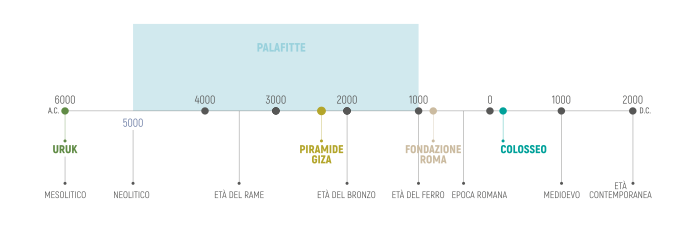
Life in the pile dwellings
The economy of the pile-dwelling villages was remarkably varied. Herds of goats, sheep and cattle provided the main source of food, alongside crops of wheat and barley stored in large clay jars; hunting and fishing completed the picture. The same communities practised a range of crafts: weaving wool and flax, knapping flint into arrowheads, sickles and scrapers, and making tools for farming, hunting and fishing. The arrival of metals — copper first, then bronze — brought weapons, utensils and jewellery, as well as building tools such as the bronze axes used to raise and maintain the piles and huts. The axe marks still visible on piles preserved in the lakebeds bear witness to that work today.

Archaeology and science
Dendrochronology
Dendrochronology is the scientific method used to date wooden finds. It rests on the analysis of tree growth rings, whose measurements are plotted as a graph known as a “dendrochronological curve”. By matching a sample’s curve against standard reference curves, researchers can establish precisely when the trees used to build the pile dwellings were felled.
Wood identification
Studying the wood under the microscope identifies the species employed, shedding light both on the environment around the settlement and on its building techniques. The preference for one species over another shows how carefully these builders matched each timber to its intended use.
Palaeobotany
Palaeobotany studies ancient plant remains — seeds, pollen, fruit and leaves — recovered from archaeological contexts. Pile-dwelling sites are exceptional archives for this kind of analysis: organic remains submerged in water, ponds or marshes survive remarkably well, because the low oxygen content slows decomposition almost to a standstill. Such studies help reconstruct the prehistoric landscape, its vegetation and how communities made use of it, and illuminate the activities that revolved around plants — from diet to farming practices.

The NeoBodio Museum of Bodio Lomnago
In the NeoBodio Museum will open in Bodio Lomnago, on the shores of Lake Varese: major archaeological finds recovered from the lakebed, a reconstruction of a pile-dwelling hut, and an immersive room screening never-before-seen footage of the pile-dwelling sites beneath the lakes of the Varese area.
DISCOVER THE MUSEUM →